
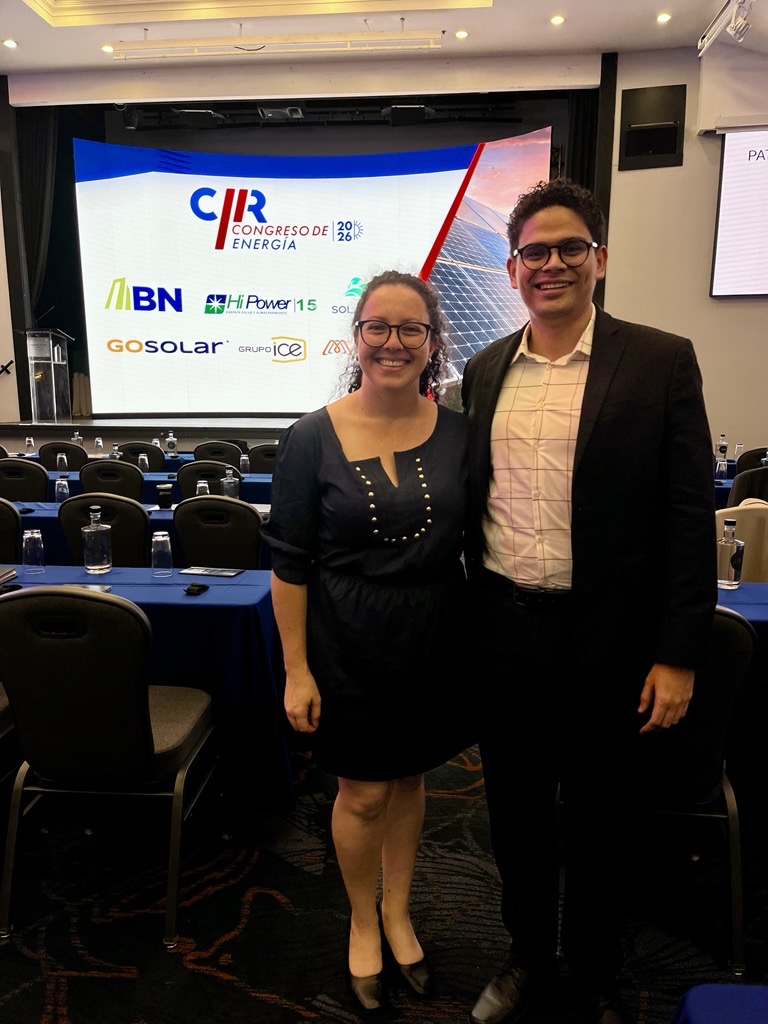
On July 30th we participated in the XVIII Energy Congress 2026, organized by the Costa Rican Chamber of Industries (CICR) at the Crowne Plaza Hotel San José La Sabana. The congress brought together key actors from the national and international energy sector around a central question: how do we navigate the energy transition in an environment marked by technological disruption, regulatory uncertainty, and climate pressures?
A sector in accelerated transition
The context could not be more challenging. Global energy markets are undergoing simultaneous reconfiguration across multiple dimensions: the sustained decline in the cost of renewable energy, the expansion of storage, the rise of electric vehicles, and the growing electrification of sectors that historically depended on fossil fuels. For Costa Rica — a country that for decades has led with an electricity grid that is nearly 100% renewable — the challenge is no longer just to maintain that advantage, but to leverage it strategically.
In this context, we shared our perspective on the value of rigorous quantitative analysis to support energy policy and investment decisions. In an environment where variables change rapidly — technology prices, regulatory frameworks, sectoral demand — the ability to model scenarios credibly becomes a strategic asset for companies, trade associations, and governments.
What we observed at the congress
The event left several takeaways that we consider relevant for our clients and partners:
Industrial decarbonization is advancing, but at different speeds. While some sectors such as transport and electricity generation show clearer trajectories of change, others like heavy industry and agriculture face technological and financing gaps that require differentiated solutions. There is no single roadmap; there are multiple transitions that must be managed in parallel.
Data is the bottleneck. Again and again, both in presentations and hallway conversations, the same problem emerged: organizations want to make better decisions, but lack the information or models to do so. This confirms what we see in our daily practice: the gap is not always one of will or resources, but of analytical capacity.
Climate finance remains an unresolved issue. Costa Rica has favorable conditions to access international climate finance instruments, but structuring bankable projects remains an obstacle. There is an opportunity for technical actors like CLG to play a bridging role between project demand and financier requirements.
Our commitment: decisions grounded in evidence
Participating in spaces like CICR’s Energy Congress allows us to test our models and analyses against the reality of the sector. It confirms that the work we do — energy modeling, decarbonization scenario analysis, climate strategy advisory — responds to concrete and urgent needs.
We remain committed to a simple premise: the best decisions are made when backed by solid evidence and rigorous analysis. In an environment as disruptive as the energy sector, that is not a luxury; it is a necessity.
If you would like to learn more about how CLG can support your organization in understanding and managing the energy transition, get in touch.